How to get a work telephone number without carrying two phones
A work number you can switch off at six, hand over when you leave, and keep off every public listing. Here's how to get one and what to check before you do.

A second phone number isn't about secrecy. It's about control over who can reach you, when, and what they learn about you. Here's who genuinely benefits.
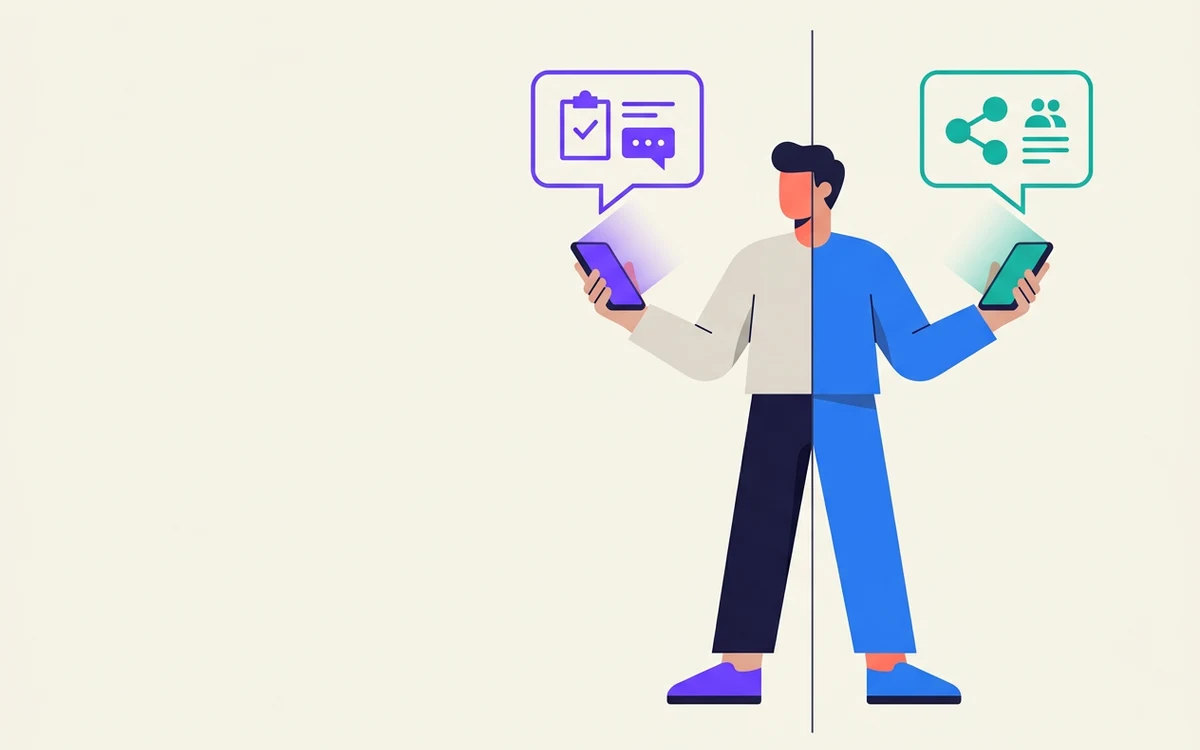
Most people have one phone number. They got it when they got their first phone, they have carried it from carrier to carrier for a decade or more, and it is now attached to their bank, their doctor, their landlord, every account they have ever opened, and roughly four hundred companies they have never heard of.
That is a lot of weight on one string of digits. A second number spreads the load.
This guide is about who actually benefits from one — not everybody does — and what changes when you have it.
A second phone number is a real, dialable number that rings on the phone you already own. No second handset, no second SIM card, no second bill from a carrier. It lives in an app, and calls and texts to it arrive alongside everything else.
The technology underneath is VoIP — the call travels over the internet rather than the cellular voice network. In practice that distinction matters less than it used to. A second number can usually do the things you expect a number to do: ring, take voicemail, send and receive texts.
What it is not: a burner in the disposable, untraceable sense. A second number is registered to you through whoever provides it. It gives you separation, not invisibility. Anyone selling you anonymity is overselling.
This is the largest group by a distance. A plumber, a bookkeeper, a dog walker, a consultant — anyone whose customers have their personal mobile number.
The problems compound quietly. Customers call at 9pm because there is nothing about the number that says "working hours." You cannot hand the phone to someone else when you go on holiday. When you eventually sell the business or hire help, the number you have given to four hundred customers is the same one your mother uses.
A second number is a boundary you can actually enforce. You can silence it at 6pm. You can let it go to a voicemail that sounds like a business. And it is portable in a way your personal number is not — it can be handed over without handing over your life.
Related but distinct. A personal mobile on an invoice reads as a side project. A dedicated line reads as a business, even when the business is one person at a kitchen table.
This is not deception; it is the same reason freelancers use a domain email rather than a free webmail address. The signal is about permanence, and clients read it.
Marketplace listings are the clearest case of all. To sell a sofa you have to let strangers contact you, and the moment your real mobile number is in a public listing it is also in the hands of every scraper watching that platform.
The number does not come back. You cannot un-publish it. A second number you can discard after the sofa sells is the correct tool, and it costs less than the sofa.
Moving a conversation off an app is normal and usually sensible. Handing over the number attached to your bank account to someone you have met twice is less sensible.
A phone number is a lookup key. Given one, plenty of services will return a name, sometimes an address, often a social profile. That is a lot to give away on a second date, and a second number lets you be reachable without being searchable.
A therapist's personal number in a client's phone is a boundary problem and sometimes a professional one. The same is true for social workers, lawyers and anyone whose clients are in distress and whose professional body has opinions about availability.
A dedicated line is not just convenience here. It is frequently a requirement.
A number that works over the internet works wherever you have data. That means your working number reaches you in another country without international roaming on the voice side, and without handing out a foreign number that nobody will call back.
Plenty of people. If your phone number is only known to friends, family and a handful of accounts, a second number is a solution without a problem.
If you already have a work phone your employer pays for, you have solved this with hardware. If your business already runs a phone system with extensions, you have solved it with infrastructure.
And if what you actually want is to never be found — a second number is the wrong tool, for the reasons above.
The honest version: less than people expect on day one, and more than they expect after a month.
Day one, you have another number that rings. The value is not in having it; it is in the habit of using the right one. The people who get the most out of a second number are strict about which number goes where — business cards, listings and forms get the second number, and the people who matter get the first.
After a month, the separation starts doing work on its own. Your personal phone stops being a work phone after hours because the work calls arrive somewhere you can mute. Spam concentrates on the number you gave to forms rather than the one your family uses. If a number does get scraped and sold, it is the one you can abandon.
That last point is the underrated one. A second number is disposable in a way your primary number is not. Being able to throw a number away and get a new one, without telling your bank, your doctor and every person you know, is most of the value.
If you decide you want one, the things that actually matter:
A second phone number is a boundary, not a disguise. It is worth having if you are running something — a business, a side project, a sale, a new relationship — where the people who need to reach you are not the same people you want to have your real number forever.
If that describes you, it is one of the cheaper problems you will ever solve. If it does not, you can safely ignore the entire category.
PhoneHub is published by AffinityClick, which also operates Hushed, a second phone number app. We write about this market because we work in it. Where we mention our own products, we say so.
A work number you can switch off at six, hand over when you leave, and keep off every public listing. Here's how to get one and what to check before you do.
A dedicated customer support number from PhoneHub is easy to set up and inexpensive to maintain, and it could be one of the easiest growth strategies you…
No phone number is HIPAA compliant on its own. What matters is whether the provider will sign a BAA — and most consumer apps will not. Here's how to check.